Longfin Rosy Barb (Puntius conchonius)
$7.99Longfin Rosy Barb (Puntius conchonius) product description coming soon.
Select options
This product has multiple variants. The options may be chosen on the product page

Showing 1–25 of 53 resultsSorted by latest

Longfin Rosy Barb (Puntius conchonius) product description coming soon.

A large growing schooling fish found in clear, fast-moving waters in Sabah, north Borneo, Hampala sabana is a predatory but relatively peaceful barb. In the aquarium, they make an excellent dither fish for other large predatory fish and will do best with some water movement and frequent large water changes. Like many larger barbs, they can be skittish and first and will do best in a group of 3-5 fish. Some cover in the form of driftwood or artificial plants (live ones will be eaten) will help them settle into the aquarium environment.

A peaceful, small schooling barb originating in the acidic, blackwater streams and swamps of Borneo, the Six Banded Barb makes an attractive display fish for a medium sized community or aquascaped tank. Active and hardy, they are found in large groups in the wild and should be kept in groups of at least 5 in the aquarium. Unlike their similar relative the Tiger Barb, this species is peaceful and not prone to nip fins, and should be kept with similarly peaceful fish.

A spectacularly marked, large-growing barb found in Southwestern India, the Mascara or Assimilis Barb inhabits clear water streams and rivers with moderate to fast flow. A shoaling fish, they are found in large aggregations in the wild and should be kept in groups of at least 5 fish in the aquarium. Both sexes will show impressive red coloration as mature adults, but males will also develop elaborate dorsal filaments and vivid red dorsal fins. A fast-moving and aggressive feeder, they should be kept with equally large and active tankmates in the aquarium.

One of the most beautifully marked of all Southeast Asian Barbs, the Snakeskin, Round Banded, or Rhombo Barb is a medium growing species found in the blackwater streams and peat swamps of Borneo. In the wild, this species inhabits warm, acidic waters and will display their best coloration when kept in similar conditions. Unlike some of their more common relatives, the Rhombo Barb is peaceful and will do well with most peaceful tankmates in the aquarium. This species will do best when kept in groups of 5 or more. Warm, acidic water and the additions of some tannins in the form of botanicals like Indian Almond Leaves will help ensure the Rhombo Barb displays their most vivid coloration in the aquarium.

A small, attractive and peaceful schooling fish, the Checker Barb comes from shallow streams and pools in Sumatra, where it is typically found in large shoals. With their active schooling nature and vivid adult coloration this species makes an excellent display fish for a medium sized community or aquascaped tank. Active and hardy, they are found in large groups in the wild and should be kept in groups of at least 5 in the aquarium. Unlike their similar relative the Tiger Barb, this species is peaceful and not prone to nip fins, and should be kept with similarly peaceful fish.

A medium growing, peaceful cyprinid found throughout Thailand and Southeast Asia, the Lemonfin or Yellowtail Tinfoil Barb is typically found in loose schools in the wild. A striking, active fish which usually inhabits well-oxygenated waters with moderate to high flow, large specimens make for an impressive display in large mixed-species aquariums. This species is a popular dither species with predatory fish and cichlid keepers as they are hardy, active, and generally compatible with most similarly-sized tankmates.

A fish with many names, the Roseline Shark, Redline Torpedo Shark, or Denisonii Barb is a vividly colored schooling fish found in the fast moving streams of Western India. With their peaceful, active nature and vibrant red, yellow, and black coloration, this fish has become a favorite in the aquarium hobby – especially among planted tank hobbyists. Although hardy, these fish prefer well-oxygenated water with some current and will display their best colors when excellent water quality is maintained. As a shoaling fish in the wild, they are best kept in groups of 5 or more in the aquarium.

A peaceful, small schooling barb originating in acidic, blackwater streams and swamps, the Eight Banded Barb (Eirmotus octozona) makes an attractive display fish for a medium sized community or aquascaped tank. Active and hardy, they are found in large groups in the wild and should be kept in groups of at least 5 in the aquarium. Unlike their other barb relatives, this species is peaceful and not prone to nip fins, and should be kept with similarly peaceful fish.

A spectacularly marked, large-growing barb found in Southwestern India, the Mascara or Apsara Barb (Dawkinsia apsara) inhabits clear water streams and rivers with moderate to fast flow. A shoaling fish, they are found in large aggregations in the wild and should be kept in groups of at least 5 fish in the aquarium. Both sexes will show impressive red coloration as mature adults, but males will also develop elaborate dorsal filaments and vivid red dorsal fins. A fast-moving and aggressive feeder, they should be kept with equally large and active tankmates in the aquarium.

Bright red and speedy swimmers, Long Fin Cherry Barbs (Puntius titteya) are a popular fish for freshwater community tanks. They reach an adult size of two inches and will generally do well with similarly sized, peaceful fish. Cherry Barbs are hardy schooling fish, and will thrive best in groups of 5 or more!

A classic aquarium fish and one of the most popular species in the hobby, the Tiger Barb is an attractive, fast-moving schooling fish best kept in groups of 5 or more. They can be considered a semi-aggressive fish but typically if kept in a large enough group they will ignore other tankmates. A hardy and adaptable fish, the Tiger Barb makes an excellent addition to most medium to large community aquariums and a great dither fish for many Central and South American Cichlids. The “Green” variant is a selectively bred strain that displays a unique green body coloration instead of the typical black stripes.

A stream-dwelling cyprinid endemic to the Western Ghats mountains of southwestern India, the Blue Spotted Hill Trout (Opsarius bakeri) is a peaceful, medium growing fish found in large shoals in the wild. They make an attractive dither fish for medium-sized peaceful fish or as centerpiece fish for a planted aquarium. They prefer well-oxygenated water and enjoy moderate to strong current in the aquarium, so the addition of one or more powerheads or circulation pumps is recommended.

One of a number of so-called freshwater “sharks” in the Cyprinid family (no actual relation to marine sharks), the black and red Red Tail Shark has been popular in the aquarium hobby for decades. Originating in well-oxygenated shallow streams in the Chao Phraya basin in Southeast Asia, this fish is a medium growing hardy omnivore and grazer that makes a colorful addition to a medium or large community aquarium. Although smaller fish do well in groups, they tend to become more solitary as they grow and can become territorial towards one another or other similar looking fish as adults. Ideal tankmates include medium peaceful cichlids, barbs, or larger rainbowfish. Albino Red Tail Shark specimens are very rare in the aquarium hobby.

Bright red and speedy swimmers, Albino Cherry Barbs (Puntius titteya) are a popular fish for freshwater community tanks. They reach an adult size of two inches and will generally do well with similarly sized, peaceful fish. Cherry Barbs are hardy schooling fish, and will thrive best in groups of 5 or more!

As a hardy and striking freshwater fish, the Snyder’s Barb (Puntius snyderi), is a fantastic choice for a community tank. These omnivorous fish are generally more peaceful than other barb species, but will still coexist best with similarly sized tankmates. These charming fish are social, and do best in a group of 5 or more!

Indonesia is home to the Apollo Shark (Luciosoma setigerum). This fish lives in swift-moving headwater streams in the wild. Typically, their habitats contain a mixture of wood, leaves, and rocks. Since they will eat any item small enough, community tanks with small fish are not advised.

The African Clipper Barb (Enteromius callipterus), also known as the African red eye barb, originates from the waters of Western Africa. They can be identified by their iridescent and silvery bodies, as well as their notable red eyes. These schooling fish are generally peaceful and can be kept with tankmates of similar size and temperament.
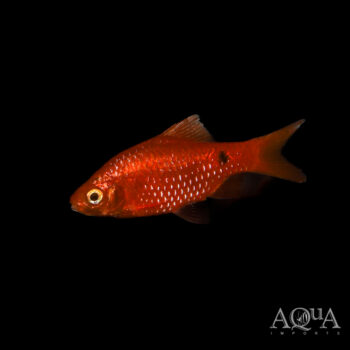
Red Rosy Barb (Puntius conchonius)

Any aquarium would benefit from the playful presence of the striking Chinese Neon Golden Stripe Shark (Sarocheilichthys parvus). Native to China, this fish inhabits small rivers. These colorful, peaceful newcomers to the aquarium hobby will quickly become your favorite fish in the tank.

Bright red and speedy swimmers, Cherry Barbs (Puntius titteya) are a popular fish for freshwater community tanks. They reach an adult size of two inches and will generally do well with similarly sized, peaceful fish. Cherry Barbs are hardy schooling fish, and will thrive best in groups of 5 or more!

One of a number of so-called freshwater “sharks” in the Cyprinid family (no actual relation to marine sharks), the black and red Red Tail Shark has been popular in the aquarium hobby for decades. Originating in well-oxygenated shallow streams in the Chao Phraya basin in Southeast Asia, this fish is a medium growing hardy omnivore and grazer that makes a colorful addition to a medium or large community aquarium. Although smaller fish do well in groups, they tend to become more solitary as they grow and can become territorial towards one another or other similar looking fish as adults. Ideal tankmates include medium peaceful cichlids, barbs, or larger rainbowfish.

A fish with many names, the Roseline Shark, Redline Torpedo Shark, or Denisonii Barb is a vividly colored schooling fish found in the fast moving streams of Western India. With their peaceful, active nature and vibrant red, yellow, and black coloration, this fish has become a favorite in the aquarium hobby – especially among planted tank hobbyists. Although hardy, these fish prefer well-oxygenated water with some current and will display their best colors when excellent water quality is maintained. As a shoaling fish in the wild, they are best kept in groups of 5 or more in the aquarium.

One of a number of so-called freshwater “sharks” in the Cyprinid family (no actual relation to marine sharks), the Black Shark or Black Shark Minnow is a large growing species found throughout much of Southeast Asia. A hardy and adaptable omnivore and grazer, they grow larger and more heavy bodied than most of their relatives and display an attractive uniform matte black coloration as adults. Although smaller fish typically do well in groups, they tend to become solitary as they grow and can become territorial and even extremely aggressive fish as adults, so tankmates should be chosen with caution.

The Golden Shark or Cigar Shark is actually a large growing member of the barb family found throughout much of Southeast Asia. It is found in a wide variety of habitat types, from fast-moving rivers to still floodplains, and is considered a food fish in most of its range. In the aquarium, it is a hardy and peaceful species but due to its very large adult size is only appropriate for very large aquariums. They make good tankmates for other large Southeast Asian species like Datnoids, large catfish or predatory but otherwise peaceful species.A secure lid is important for this species as they are powerful jumpers.
End of content
End of content
No products in the cart.